EMAIL US
sales@scanneroptics.com
Laser beam expanders are critical optical components in laser galvanometer systems, widely used in laser cutting, welding, marking, LiDAR, semiconductor lithography, and scientific ultrafast laser systems. This article introduces their main functions and explains how to select the right beam expander based on wavelength, materials, coatings, and application requirements.
A laser beam expander is essentially a telescope optical system used in reverse. By combining lenses of different focal lengths, it achieves beam diameter expansion and a reduction in the divergence angle. The expanded laser beam produces a smaller focused spot, thereby improving laser processing accuracy and energy density. The higher the beam expansion ratio, the larger the output beam diameter and the smaller the far-field divergence angle. Therefore, beam expanders are crucial for high-precision processing, long-distance transmission, and LiDAR systems.
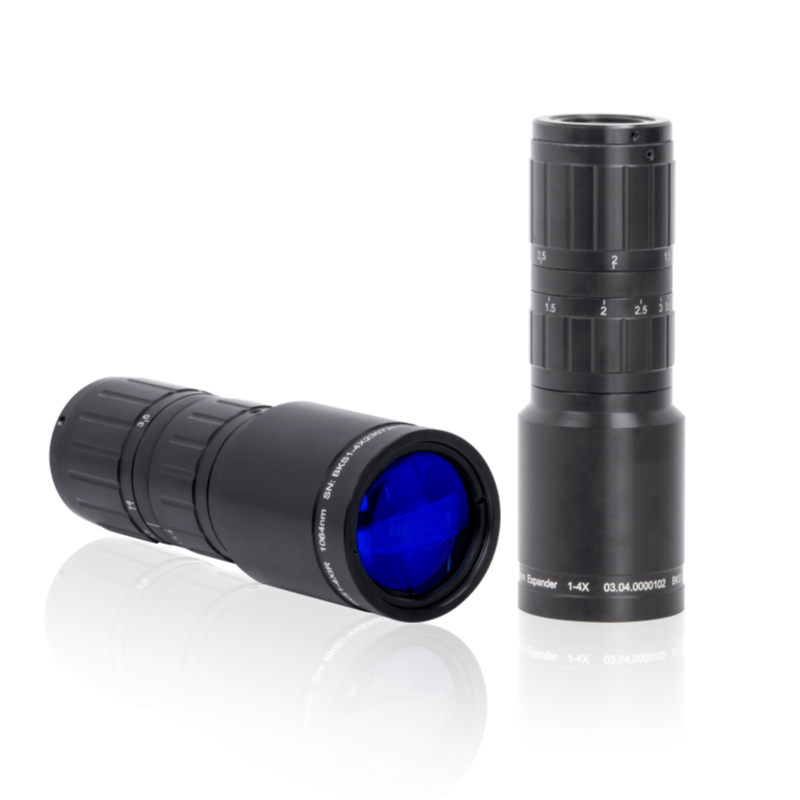
In practical selection, aside from wavelength and parameters, laser beam expanders can be categorized into two main types based on their optical structure. Different structures directly impact system performance and application limits.
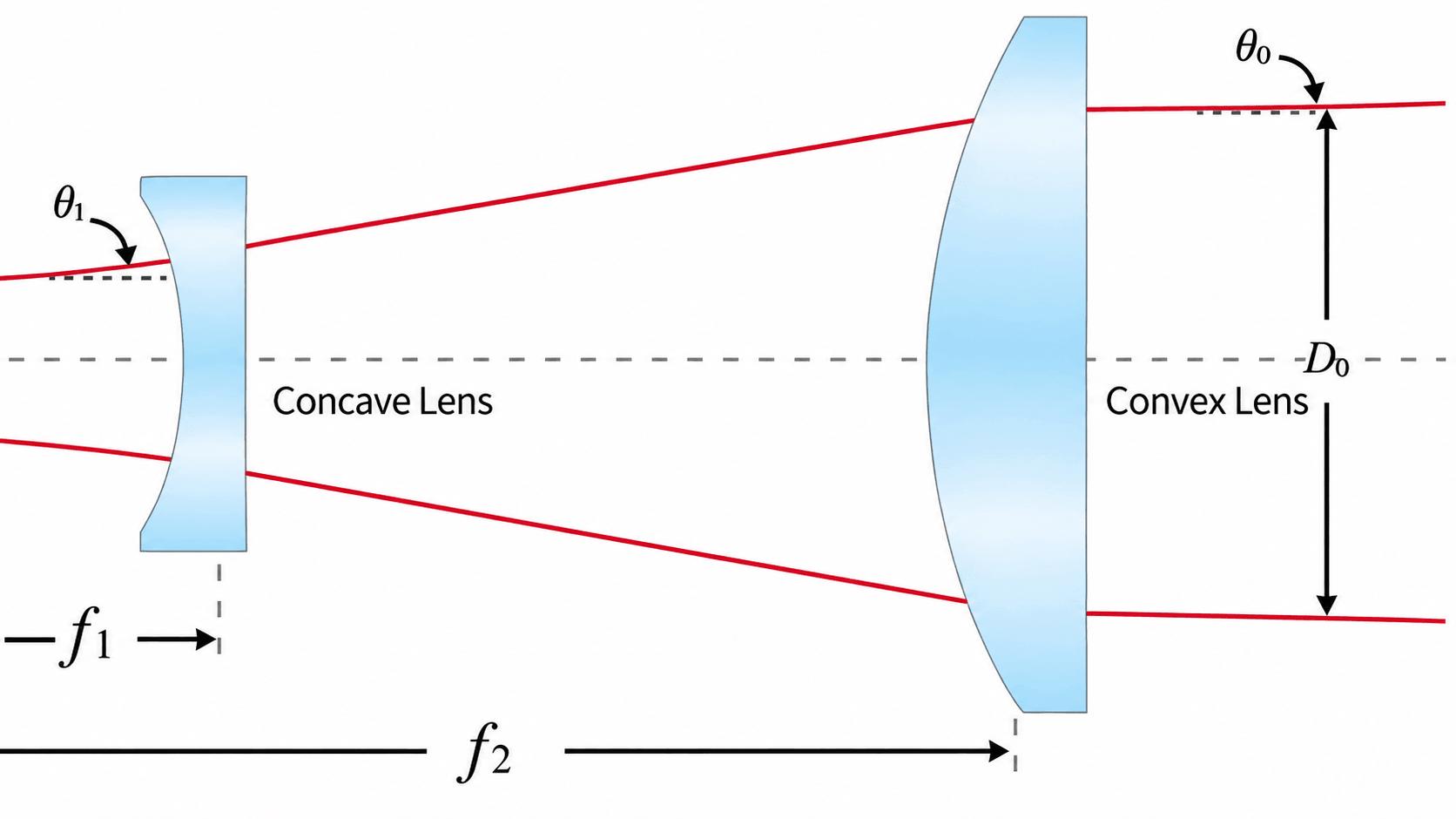
Galilean beam expanders consist of a “concave lens + convex lens” configuration. Their defining feature is the absence of an internal focal point, resulting in a compact structure with a short overall length. This design is less susceptible to focal damage caused by high-power lasers, making it suitable for high-power applications such as industrial laser processing, cutting, welding, and marking. However, due to the lack of an internal focal point, they cannot perform spatial filtering, and their ability to improve beam quality is relatively limited.
Keplerian beam expanders consist of “two positive lenses” and feature a real focal point at the center. Consequently, they possess spatial filtering capabilities and can effectively improve beam quality, making them suitable for applications with high beam quality requirements, such as semiconductor lithography, ultrafast laser systems, and research-grade optical experiments. However, due to the presence of an internal focal point, greater caution is required in high-power laser applications. Additionally, their structural length is longer, and they are more expensive.
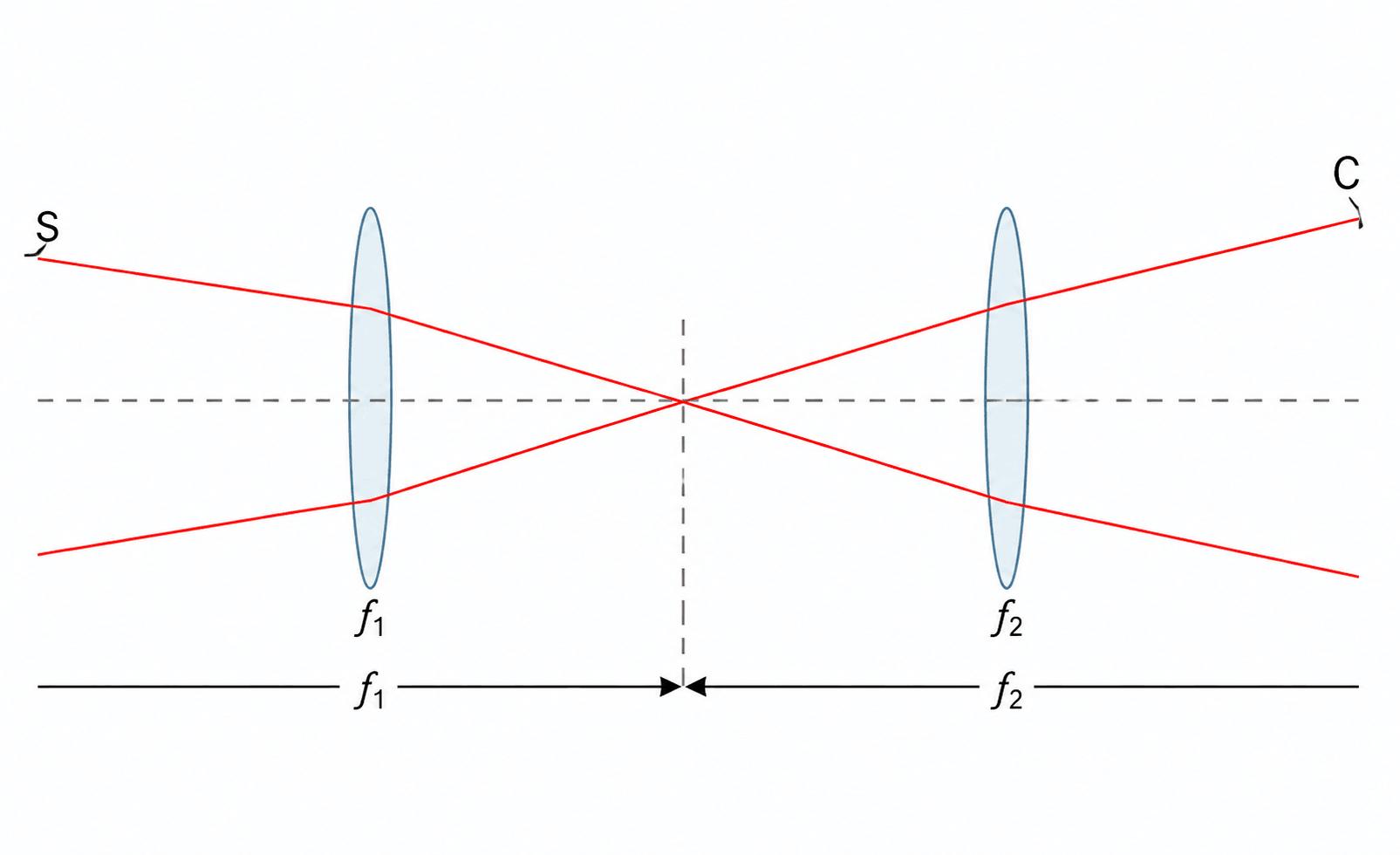
In practical selection, a simple rule of thumb is: prioritize Galilean-type beam expanders for industrial high-power applications, while Kepler-type expanders are better suited for scenarios requiring high precision and high beam quality.
When selecting a beam expander, the first step is to confirm the laser wavelength. The coatings on beam expanders are designed for specific wavelength bands, such as 355 nm UV lasers, 532 nm green lasers, 1064 nm fiber lasers, and 10.6 μm CO₂ lasers. The corresponding coatings and materials are entirely different and are generally not interchangeable across wavelength bands. Second, the beam expansion ratio must be considered. Common expansion ratios in industrial applications are 2×, 3×, 5×, and 10×. A higher ratio provides stronger focusing capability, but system size and cost also increase accordingly; therefore, a higher ratio is not necessarily better.
For high-power laser systems, the laser damage threshold (LDT) must also be a key consideration. If the beam expander cannot withstand the laser energy, it may result in coating burnout or lens cracking. It is generally recommended to allow for a safety margin of at least 30%. Additionally, wavefront distortion is a critical factor affecting beam quality. High-precision laser processing and research applications typically require low wavefront error to ensure a more uniform and stable focused spot.
| Application | Laser Wavelength | Recommended Structure | Recommended Material | Expansion Ratio | Key Considerations |
| Industrial Laser Cutting | 1064 nm | Galilean Type | Fused Silica | 2×–5× | High damage threshold, system stability |
| Laser Welding / Cleaning | 1064 nm | Galilean Type | Fused Silica | 2×–4× | Thermal stability, coating quality |
| Laser Marking | 532 nm / 1064 nm | Galilean Type | K9 / Fused Silica | 2×–3× | Cost efficiency, beam spot quality |
| Semiconductor Lithography | 193–355 nm | Keplerian Type | CaF₂ / Fused Silica | 10×–20× | Wavefront quality (λ/10 level) |
| Ultrafast Laser Processing | 800–1064 nm | Keplerian Type | Fused Silica | 5×–10× | Low dispersion, low nonlinear effects |
| CO₂ Laser Cutting | 10.6 μm | Galilean Type | ZnSe | 2×–3× | IR transmission efficiency, laser damage threshold |
For 355 nm UV beam expanders, material resistance to aging must be a primary consideration in environments with prolonged UV exposure. Particularly in high-repetition-rate laser systems, coating stability is a key factor affecting service life.
For 1064nm near-infrared beam expanders in high-power fiber laser systems, in addition to material selection, special attention must be paid to thermal lensing effects and thermal drift caused by coating absorption.
Since 10.6μm CO₂ laser beam expanders operate in the far-infrared band, they are extremely sensitive to material absorption. Therefore, specialized infrared materials such as ZnSe must be used, and surface cleanliness requirements are extremely high.
Many users believe that beam expanders merely amplify the beam and can therefore be used interchangeably across different wavelength bands. This is the most common and dangerous mistake. For example, a 1064 nm beam expander must never be used in a CO₂ laser system, as the lens would instantly absorb a large amount of laser energy and shatter.
Another common issue is focusing solely on the expansion ratio while neglecting the input aperture. An input aperture that is too small will shear the laser edges, causing diffraction effects and resulting in degraded spot quality. Therefore, the input aperture of a beam expander typically needs to be at least 1.5 times larger than the laser beam diameter.
Furthermore, in high-power applications, price should not be the sole consideration. Low-end beam expanders often use ordinary glass or coatings with low damage thresholds; while they may be cost-effective in the short term, their long-term stability and lifespan will be significantly compromised.
The core selection criteria for laser beam expander lenses can be summarized as follows: match the material and coatings to the wavelength band, match the power to the damage threshold, and match the structure and precision to the application scenario.
For industrial laser systems, industrial-grade beam expanders made of materials with high damage thresholds and low thermal expansion are generally recommended.
For high-end applications such as ultrafast lasers and semiconductor lithography, research-grade beam expanders with low wavefront distortion are required to achieve better beam quality and system stability. As laser technology continues to evolve toward higher power, shorter wavelengths, and ultrafast operation, multi-wavelength compatible, high damage threshold, and highly stable beam expanders will also become key development trends in the future.
Last Updated: May 29, 2026
 zh-CN
zh-CN
 English
  日本語
日本語  한국어
한국어  français
  Deutsch
  Español
  italiano
  русский
  português
  tiếng việt