EMAIL US
sales@scanneroptics.com
In galvanometer scanner systems, the F-Theta lens is one of the most important optical components determining scanning accuracy, spot quality, and processing efficiency. Whether the system is used for laser marking, engraving, welding, cleaning, or micromachining, selecting the correct scanning lens has a direct impact on processing performance.
Unlike ordinary focusing lenses, the F-Theta lens is specifically designed for galvanometer scanning systems. In a typical laser scanning head, the galvo mirrors are driven by high-speed galvo motors, and the F-Theta lens ensures a predictable relationship between the mirror deflection angle and the position of the laser spot on the working surface.
The fundamental principle behind this design can be expressed as:
y=f*θ
Here, y represents the position of the focused laser spot on the working plane, f represents the focal length of the lens, and θ represents the deflection angle of the galvanometer mirror. Because the image height is proportional to the scan angle, the F-Theta lens allows the laser spot to move across the work surface in an approximately linear fashion when the galvo mirrors rotate at constant angular velocity.
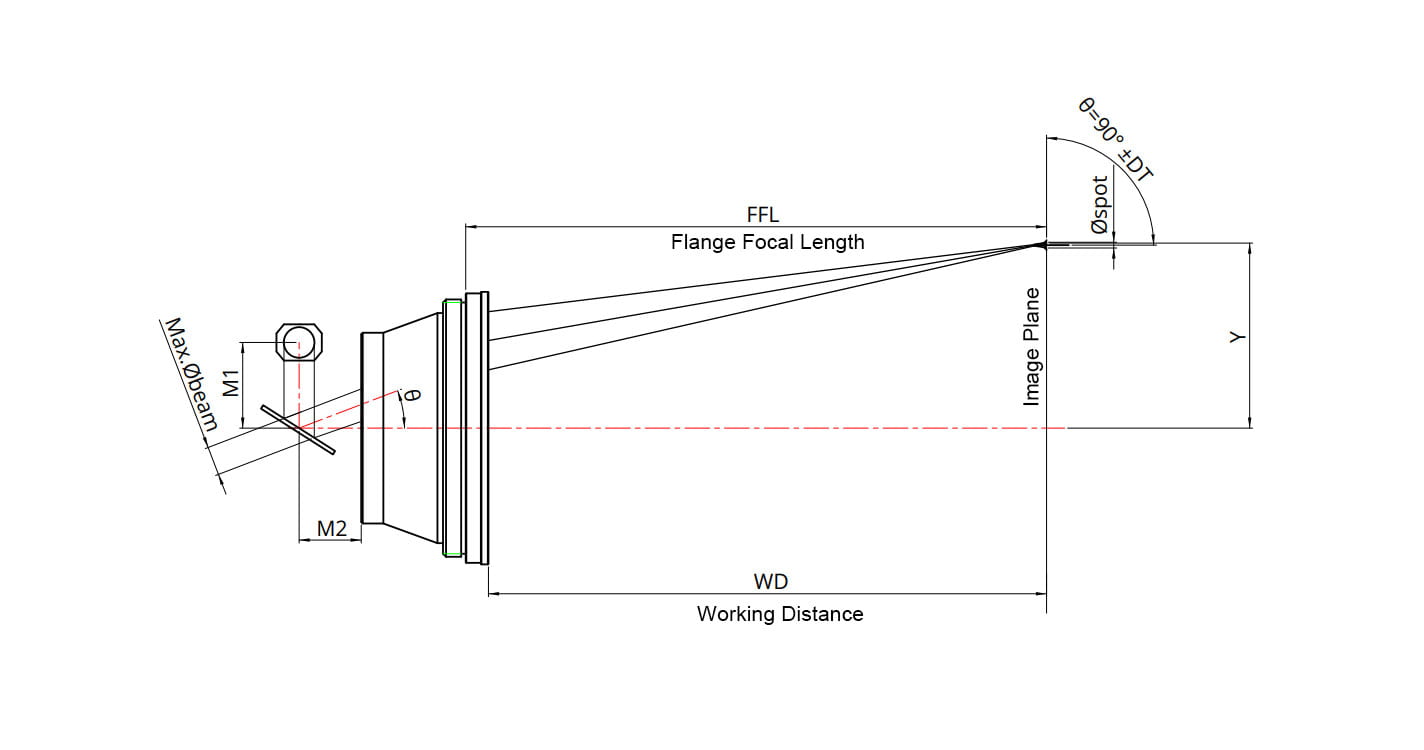
This characteristic makes the F-Theta lens essential for achieving uniform scanning speed and consistent processing quality across the entire marking field.
The F-Theta lens design differs significantly from conventiona imaging optics. A standard lens normally focuses light according to the tangent relationship between field angle and image position, which leads to distortion when used in scanning systems.
The F-Theta optical design compensates for this effect by introducing controlled distortion inside the lens system. This correction ensures that the scanning position on the work surface remains proportional to the mirror deflection angle.
In practice, an F-Theta lens is designed to produce:
A flat focal plane for laser processing
Minimal spot size variation across the scan field
Controlled distortion for linear scanning motion
Stable optical performance across the working area
These characteristics allow galvanometer scanners to maintain consistent laser spot movement and processing precision, even at high scanning speeds.
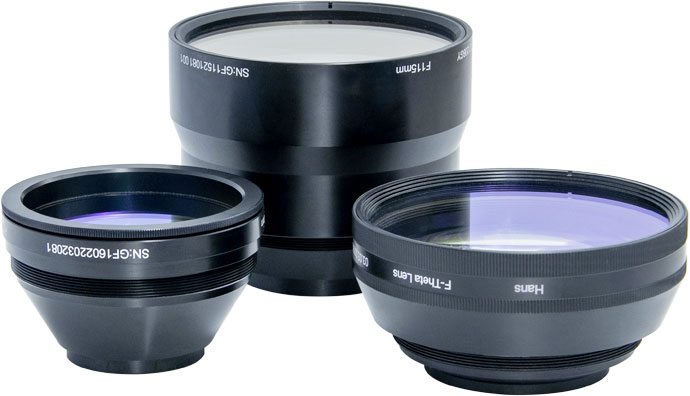
F-Theta lenses can be classified according to both optical structure and application.
From a structural perspective, some lenses use a simple optical configuration with only one element, while others use multiple elements to improve aberration correction and spot uniformity. Multi-element lenses are more complex but generally provide better optical performance, especially for large scanning fields or high-precision laser processing.
Another important classification relates to laser wavelength compatibility. Because optical materials and coatings must match the laser source, F-Theta lenses are designed for specific wavelengths. Common examples include UV laser systems operating around 355 nm, green lasers around 532 nm, fiber lasers around 1064 nm, and CO₂ laser systems operating near 10.6 μm.
Selecting a lens designed for the correct wavelength ensures optimal optical transmission, stable beam quality, and long-term reliability.
One of the most critical parameters in lens selection is the F-Theta lens focal length, which directly determines the size of the scanning field.
In most galvanometer systems, the effective marking field is roughly proportional to the focal length of the lens. As the focal length increases, the available scaning area becomes larger. This allows the system to process bigger parts or mark larger surfaces.
However, increasing the focal length also introduces several trade-offs. A longer focal length typically results in a larger focused laser spot, which reduces laser power density and may affect engraving depth or processing precision. Additionally, larger scan fields often introduce greater distortion toward the edges of the marking area.
For this reason, selecting the appropriate F-Theta lens focal length is always a balance between required marking area and desired processing precision.
The diameter of the focused laser spot is one of the most important factors affecting processing quality in laser marking and micromachining applications. A simplified relationship describing the focused spot diameter is given by:
d=2fλ/D
In this equation, d represents the focused spot diameter, f is the focal length of the lens, λ is the laser wavelength, and D is the diameter of the incoming laser beam.
From this relationship it becomes clear that increasing the focal length leads to a larger spot size. Similarly, longer laser wavelengths produce larger spots. Conversely, increasing the incoming beam diameter helps reduce the focused spot size and improves processing resolution.
Because laser power density is inversely proportional to the square of the spot diameter, even small increases in spot size can significantly reduce the available energy density at the work surface.
This explains why large scanning fields sometimes require higher laser power in order to achieve the same marking depth.
Another important factor in F-Theta lens selection is the entrance pupil diameter of the lens. The entrance pupil should ideally match the beam diameter delivered by the galvanometer scanner.
The beam diameter at the scanner output is determined by the original laser beam size and the expansion ratio of the beam expander. If the beam entering the lens is larger than the entrance pupil, part of the beam will be clipped. This may not significantly affect the center of the marking field, but it can reduce energy density at the edges of the scan area.
This mismatch often results in uneven marking depth across the workpiece, which is a common issue in poorly optimized laser systems.
When selecting an F-Theta lens, engineers must also consider the working distance, which is the distance between the lens and the work surface at focus.
Large scanning lenses designed for wide marking areas often require longer working distances. This can introduce mechanical design constraints for the laser machine. The vertical travel of the Z-axis column must be sufficient to accommodate the scanner head, the lens assembly, and the height of the workpiece.
Ignoring this factor during system design may result in a situation where the machine cannot reach the correct focal position.
In high-precision applications, engineers sometimes use a Telecentric F-Theta lens instead of a standard F-Theta lens.
A telecentric design ensures that the laser beam remains perpendicular to the work surface across the entire scan field. This provides several advantages in applications where dimensional accuracy is critical.
For example, a Telecentric F-Theta lens can significantly reduce distortion in applications such as semiconductor processing, precision electronics manufacturing, and micro-pattern fabrication.
However, telecentric lenses are typically larger, heavier, and more expensive than standard F-Theta lenses. Therefore they are usually selected only for applications requiring extremely high accuracy.
When selecting an F-Theta lens for a galvo laser system, several key factors should be considered to ensure stable optical performance and suitable processing quality.
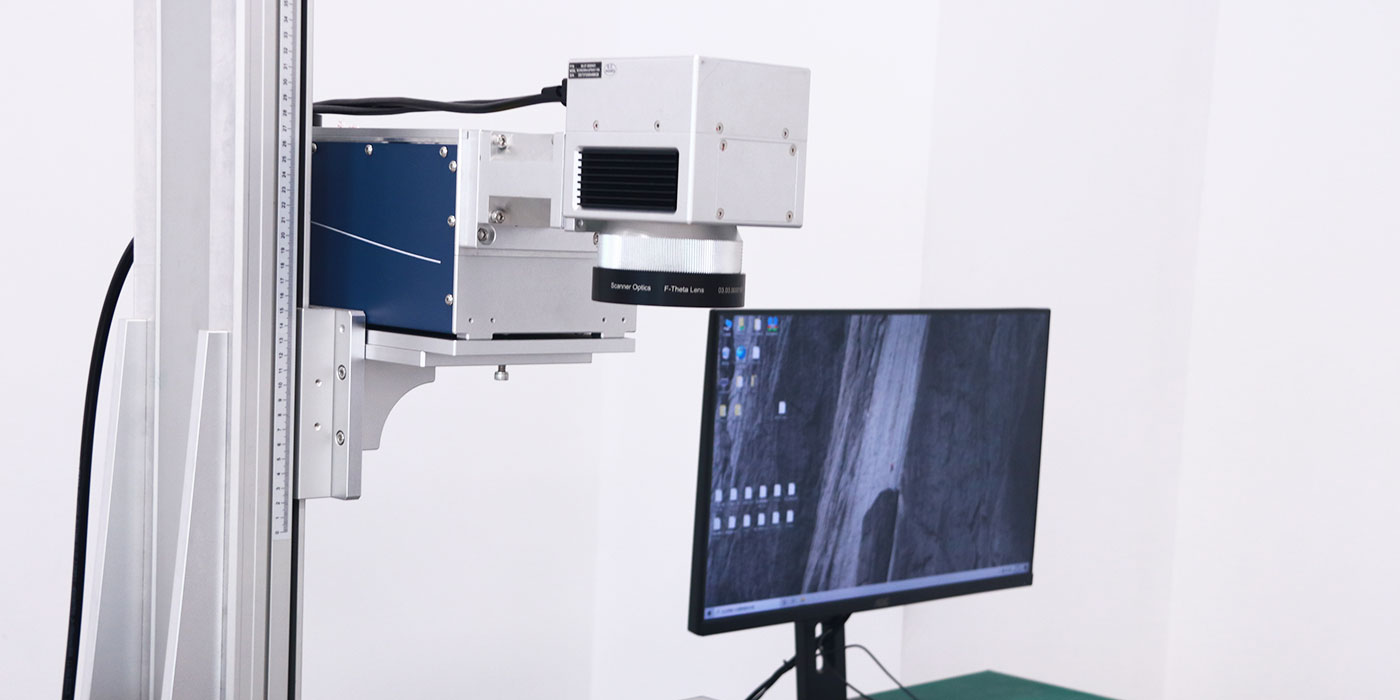
First, the working wavelength of the lens must match the laser source. Different lasers operate at different wavelengths, and the optical materials and coatings of the F-Theta lens are designed specifically for those wavelengths. For example, fiber lasers operating at 1064 nm require lenses optimized for 1064 nm, CO₂ lasers at 10.6 μm require ZnSe lenses designed for CO₂ systems, and green lasers at 532 nm require coatings optimized for visible wavelengths. The choice of wavelength is also related to the absorption characteristics of the processed material and the cost of the laser souce.
Another important parameter is the focal length of the F-Theta lens, which determines the available scan field. In many laser scanning systems, the effective marking area can be roughly estimated using the empirical relationship:
scan field (mm) ≈ 0.7 × focal length (mm)
A longer focal length provides a larger scanning area, but it also increases the focused spot size and reduces laser power density. As a result, processing precision may decrease. Therefore, the focal length must be selected by balancing the required processing area with the desired resolution. Large-area processing typically requires long focal length lenses, while fine marking or micromachining applications usually benefit from shorter focal lengths and smaller laser spots.
The clear aperture of the lens should also match the galvanometer scanner aperture. For example, a 20 mm galvo scanner is typically paired with an F-Theta lens with a similar entrance pupil diameter. To avoid beam clipping, the incoming beam diameter should ideally be no more than 50–75% of the lens entrance pupil. Proper matching helps maintain uniform laser energy distribution across the entire scan field.
In terms of optical design, standard flat-field F-Theta lenses are widely used in most laser processing applications because they provide good scanning linearity and stable optical performance. In contrast, telecentric F-Theta lenses are designed for high-precision applications where the laser beam must remain perpendicular to the work surface across the entire scan field. Although telecentric lenses offer higher dimensional accuracy, they are typically larger and more expensive.
The lens material is another important consideration. Conventional optical glass such as K9 is often used for lower-power systems due to its stable performance and low cost. Fused silica is commonly used in medium- and high-power applications because of its excellent thermal stability and wide transmission range. Materials such as Corning 7980 can support a broad wavelength range from UV to infrared. For CO₂ laser systems, ZnSe lenses are commonly used because of their high transmission at 10.6 μm.
Finally, mechanical compatibility should also be considered. The mounting thread interface of the F-Theta lens must match the scanner housing or machine platform. If the interfaces are not compatible, an adapter ring may be required. For custom optical designs, additional parameters such as pulse duration, pulse energy, and beam quality (M² factor) may also be needed to optimize the lens for specific laser processing applications. Selecting the right F-Theta lens requires balancing scan field size, spot size, and system compatibility. A well-matched lens ensures stable scanning performance and consistent laser processing quality.
 zh-CN
zh-CN
 English
  日本語
日本語  한국어
한국어  français
  Deutsch
  Español
  italiano
  русский
  português
  tiếng việt