EMAIL US
sales@scanneroptics.com
A laser processing system is more than just a laser, a lens, and a workpiece. Think of it as a complete laser processing system where every part has a different job. The laser generates the energy, the optics shape the beam, the scanner moves the beam to the right position, the focusing lens concentrates the energy onto the workpiece, and the motion system keeps every laser pulse in the correct place.
As laser sources become more powerful, a new challenge appears. The laser is no longer the limiting factor—the beam cannot be moved fast enough. This is one of the main reasons why polygon scannning systems have been developed.
A typical laser processing system uses a galvo scanner for beam positioning. The optical path can be simply understood as:
Laser source → Beam expander → XY galvo scanner → F-theta scan lens → Workpiece
The X-axis and Y-axis galvo mirror controls the beam deflection in two directions.
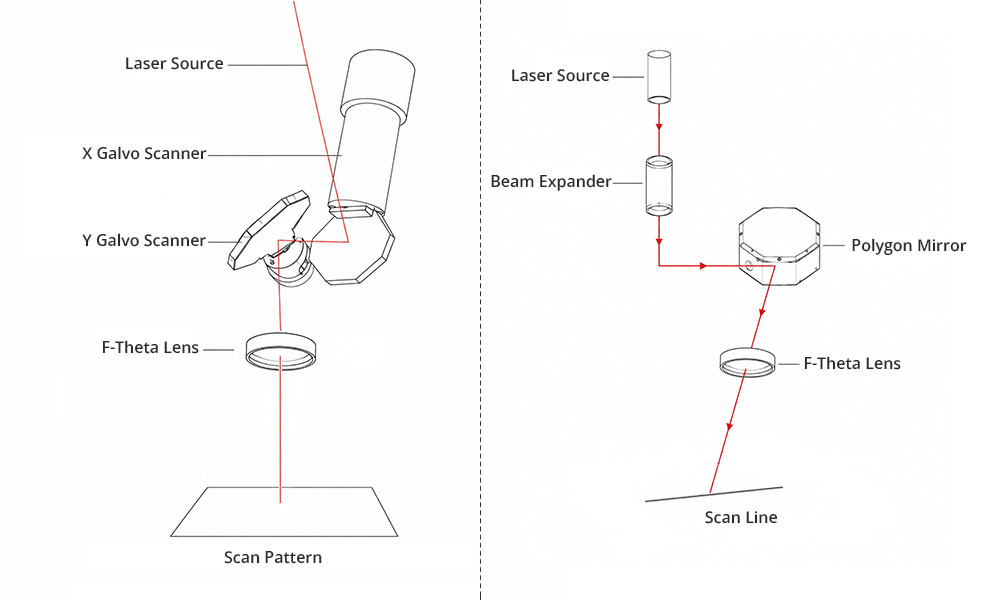
Galvo scanner vs. polygon scanner scanning principle
A galvo scanner offers several advantages, including flexible scan areas, programmable trajectories, and high positioning accuracy. Therefore, galvo scanner systems are widely used in laser marking, cutting, drilling, welding, and microstructure processing.
However, a galvo scanner relies on oscillating mirrors. The mirror needs to repeatedly accelerate, decelerate, and change direction during operation. As the scanning speed increases, mechanical inertia becomes more significant. At higher scanning frequencies, problems such as tracking errors, phase delay, edge distortion, and thermal stability become more challenging.
For conventional laser marking applications, these limitations are usually not critical. However, for high-repetition-rate and high-average-power ultrashort pulse laser micromachining, they can become a bottleneck for system performance.
The core component of a polygon scanner is a high-speed rotating polygon mirror with multiple reflective facets.
Unlike a galvo scanner, which moves a mirror back and forth, a polygon scanning system continuously rotates multiple mirror facets. When each facet passes through the incident laser beam, it completes a high-speed line scan. After one facet finishes scanning, the next facet immediately enters the working position and continues the next scanning line.
A polygon scanner is designed for one thing: high-speed line scanning.
In ultrashort pulse laser micromachining, material removal efficiency is closely related to pulse energy, repetition rate, pulse overlap ratio, and scanning speed.
As the laser repetition rate increases, more pulses can theoretically be used for processing within the same period. However, the scanning system must be fast enough to distribute these pulses at appropriate spatial positions.
If the scanning speed is too slow, consecutive laser pulses keep hitting nearly the same location. Excessive local energy accumulation may reduce both processing efficiency and quality.
The key benefit of a polygon scanner is that it can spread high-frequency laser pulses across the material surface, allowing laser power to be effectively converted into processing area and production throughput.
This scanning method is especially suitable for large-area, high-repetition-rate, line-oriented laser processing tasks.
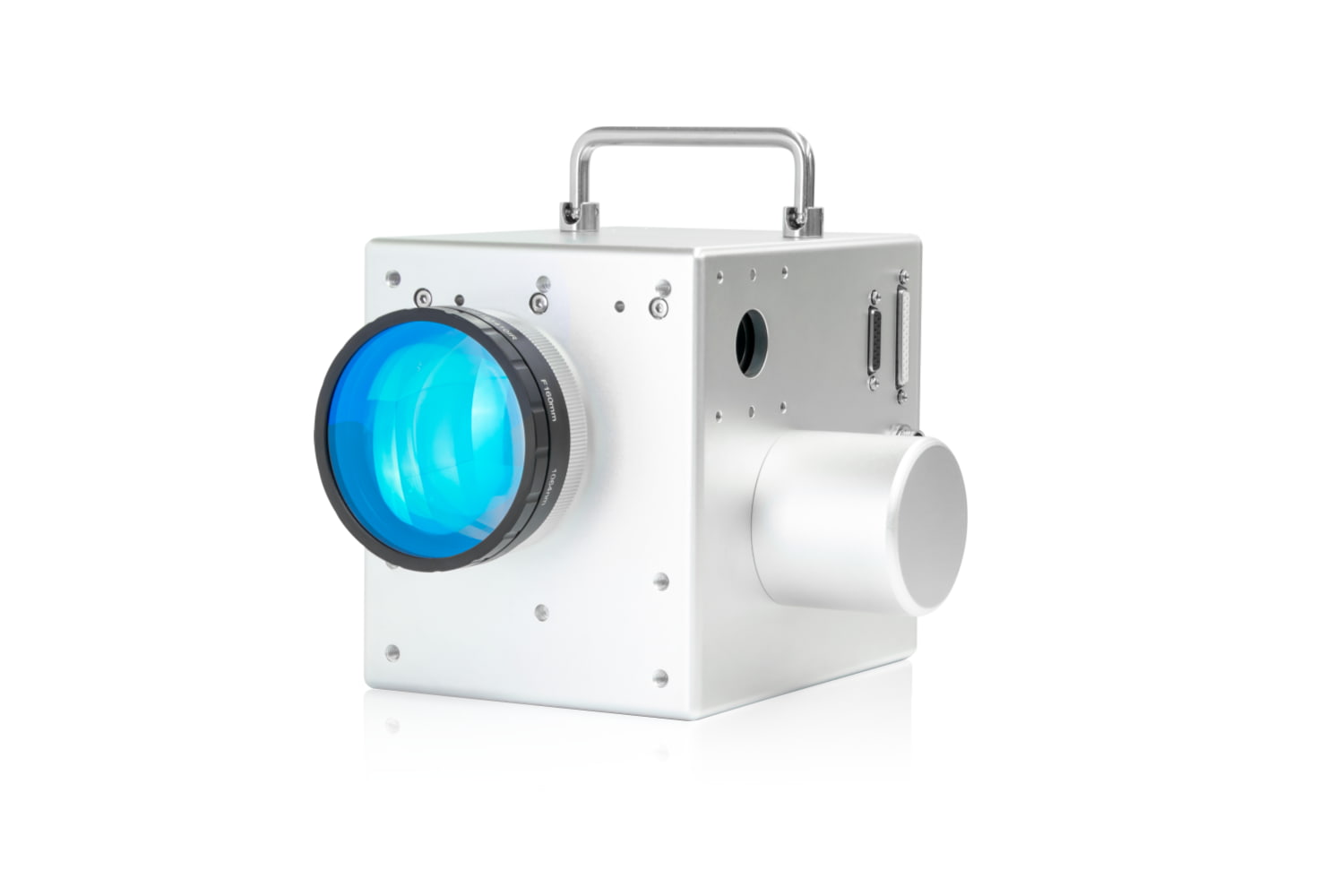
Polygon scanners are particularly suitable for full-surface and line-based processing applications, where high scanning speed can significantly reduce material processing time.
Large-area surface texturing
Selective thin-film removal
Microstructure array fabrication
Continuous laser processing
High-throughput micromachining production lines
Ultrashort pulse lasers generally refer to picosecond and femtosecond laser systems. Their characteristic feature is an extremely short pulse duration, which allows energy to be deposited into the material surface within a very short time, enabling high-precision material removal.
Ideally, the material is removed rapidly with minimal heat affected zone, which is why ultrashort pulse lasers are widely used in applications such as surface texturing, microchannel fabrication, thin-film removal, and precision laser engraving.
However, when the laser repetition rate and average power continue to increase, the scanning speed must also increase accordingly. If the scanning speed cannot keep up, adjacent laser pulses will overlap excessively in space, which may cause several problems:
1. Increased local heat accumulation and reduced processing quality;
2. Excessive energy density per unit area, resulting in unstable material response;
3. Insufficient utilization of expensive laser power.
Therefore, for high-power ultrashort pulse lasers to achieve true industrial high-throughput production, a more powerful laser source alone is not enough. A faster beam scanning system is also required — this is where polygon scanning technology becomes important.
The laser source determines how fast energy is generated, while the scanning system determines how fast that energy can be delivered accurately to the material surface.
The two must be properly matched.
The most attractive feature of a polygon scanner can be summed up in one word: speed.
A polygon scanner achieves continuous line scanning through a high-speed rotating multi-facet mirror. Unlike a conventional galvo scanner, which repeatedly accelerates, decelerates, and reverses direction for every scan line, a polygon scanner performs continuous scanning by rotating multiple mirror facets in sequence. As one facet completes a scan line, the next immediately enters the working position. This architecture is particularly well suited for high-repetition-rate laser processing, especially large-area processing, regular line-pattern scanning, and continuous surface treatment. For ultrafast laser applications, a polygon scanner rapidly distributes high-frequency laser pulses across the material surface, reducing excessive pulse overlap in the same area and allowing high-average-power lasers to be translated into higher processing throughput.
Its main advantages can be summarized as follows:
A polygon scanner achieves high-speed fast-axis scanning through continuous rotation, making it suitable for line scanning at speeds of tens of meters per second or even higher. For applications such as large-area surface texturing, thin-film removal, and microstructure array fabrication, scanning speed directly determines the amount of material that can be processed within a given time.
A conventional galvo scanner requires repeated oscillation, resulting in acceleration and deceleration at the edges of each scan. In contrast, a polygon scanner rotates continuously in one direction, creating a motion profile that is closer to steady-state operation. For repetitive line scanning tasks, this continuous motion helps improve both processing throughput and overall system stability.
When a high-repetition-rate laser is combined with a slow scanning system, excessive pulse overlap, increased heat accumulation, and reduced processing efficiency can occur. The high-speed line scanning capability of a polygon scanner enables laser pulses to be distributed more evenly across the workpiece, making better use of high-frequency laser output.
However, these advantages come with several trade-offs.
A galvo scanner can generate complex two-dimensional trajectories based on control signals, making it ideal for arbitrary path processing and intricate geometries. A polygon scanner, by contrast, is inherently optimized for high-speed linear scanning. Processing complex two-dimensional patterns typically requires additional motion stages, slow-axis scanners, or sophisticated synchronization control.
A polygon scanner contains multiple reflective facets. Variations in facet angle, surface accuracy, reflectivity, or assembly tolerance can all affect consistency between scan lines. While these errors may be negligible in display systems or low-precision scanning applications, they can appear in precision laser processing as line-to-line positioning errors, energy variations, or non-uniform processing textures.
Because a polygon scanner operates at extremely high speed, the time window during which the laser spot moves across the workpiece is very short. Laser pulses must be triggered at precisely the right moment, while the slow-axis stage must advance at the correct timing. Even slight synchronization errors between laser triggering, mirror position, and workpiece motion can result in variations in pulse spacing, pattern distortion, or processing area drift.
Polygon scanning involves much more than simply reflecting the laser beam. After high-speed scanning, the beam must still pass through the focusing optics before reaching the workpiece. Throughout the scanning field, parameters such as spot size, focal position, angle of incidence, and energy density must remain as consistent as possible. Otherwise, processing quality will vary across the scan field.
High-speed rotation introduces challenges such as dynamic balancing, bearing performance, vibration, thermal drift, and air turbulence. Even minor mechanical runout can ultimately translate into beam positioning errors. For precision laser processing systems, a polygon scanner must not only rotate at high speed, but also maintain exceptional rotational stability.
A polygon scanner is not simply a replacement for a galvo scanner. Instead, it is a specialized high-speed scanning solution designed for high-throughput line scanning applications.
If the application requires complex patterns, flexible scanning paths, or small-batch production, a galvo scanner remains an excellent choice. However, for large-area processing, repetitive line patterns, and high-speed continuous manufacturing, the advantages of polygon scanning become much more apparent. Simply put, a galvo scanner excels at drawing flexibly, while a polygon scanner excels at scanning rapidly.
In laser processing systems, the key is not deciding which technology should replace the other. Rather, it is selecting the right scanning solution based on the application requirements and optimizing speed, accuracy, synchronization, and optical design as an integrated system.
If you're considering polygon scanning for your laser processing application, contact us to discuss your project.
 zh-CN
zh-CN
 English
  日本語
日本語  한국어
한국어  français
  Deutsch
  Español
  italiano
  русский
  português
  tiếng việt