EMAIL US
sales@scanneroptics.com
As the demand for precision manufacturing and environmentally friendly production continues to grow, laser cleaning has become increasingly popular across industries thanks to its non-contact operation, consumable-free process, high precision, and ease of automation. Today, laser cleaning is widely used in automotive manufacturing, aerospace, power batteries, rail transportation, electronics manufacturing, cultural heritage restoration, and many other fields.
But how can laser cleaning remove contaminants without damaging the underlying material? What is the science behind this technology?
This article provides a comprehensive overview of the working principles, classifications, characteristics, and typical applications of laser cleaning.
The ability of laser cleaning to achieve non-destructive cleaning lies in its unique operating principle. Simply put, laser cleaning precisely controls laser parameters—including wavelength, pulse duration, and energy density—typically in combination with a galvo scanner, allowing the laser beam to selectively interact with contaminants or oxide layers while leaving the substrate intact. It is also one of the most widely used applications of laser ablation.
Specifically, the laser energy density is adjusted to remain below the damage threshold of the substrate while exceeding the ablation threshold of the contaminant or oxide layer. As the laser irradiates the surface, contaminants efficiently absorb the laser energy and are rapidly removed through vaporization or decomposition. In contrast, the substrate absorbs little or no laser energy, allowing it to remain undamaged.
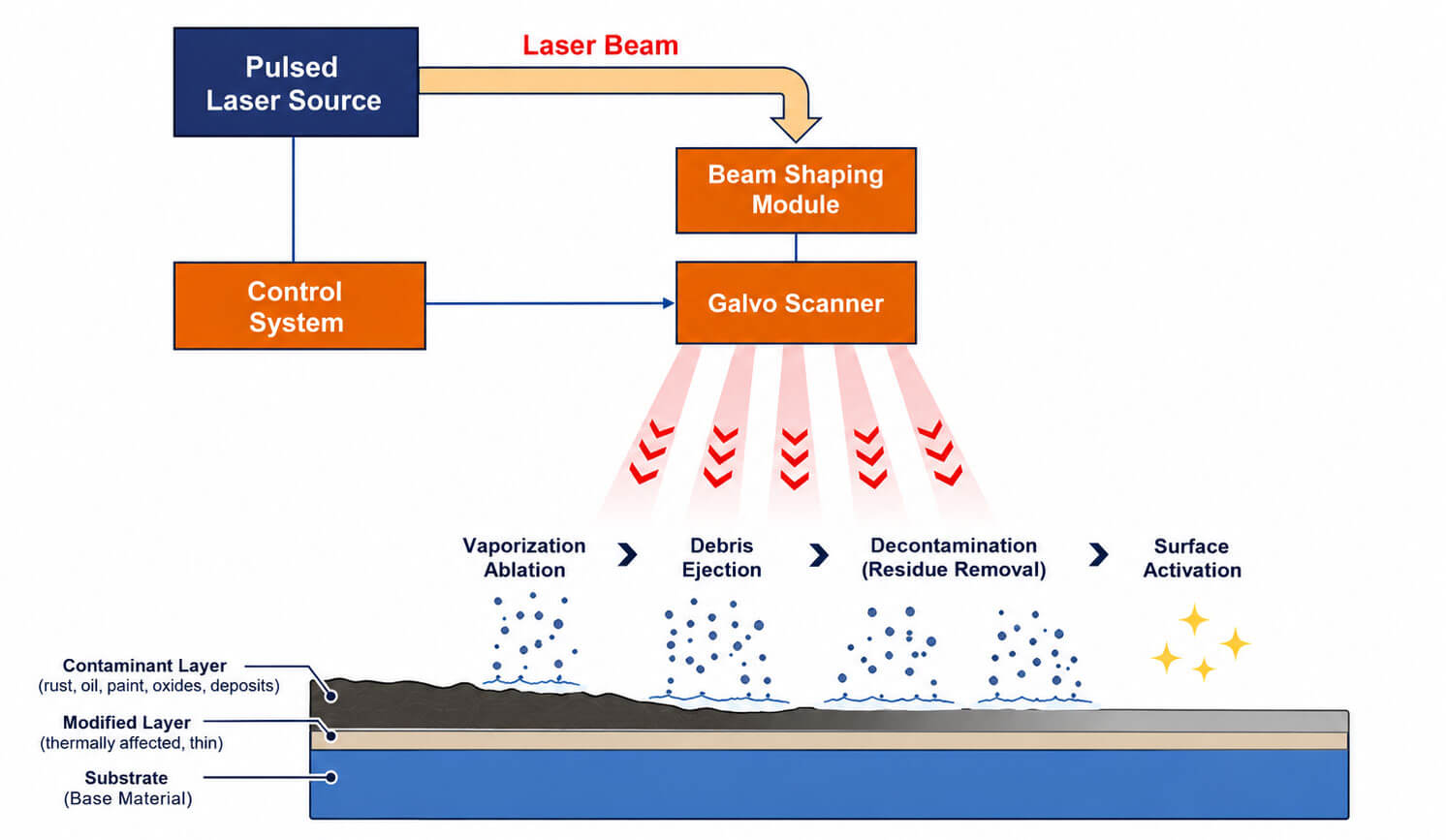
Based on the interaction between the laser and the workpiece surface, laser cleaning can be classified into direct-contact cleaning and indirect-contact cleaning.
According to different removal mechanisms, direct laser cleaning can be divided into three categories:
1. Direct Pulsed Laser Ablation
A pulsed laser directly irradiates the contaminated surface. Since contaminants generally absorb laser energy much more efficiently than the substrate, they are rapidly removed through vaporization, laser ablation, photochemical reactions, and thermal decomposition.
In the center of the laser spot, contaminants are primarily removed by vaporization and ablation, while at the edges they are detached through thermal stress, thermal shock, and mechanical fracture.
2. Liquid-Film Assisted Laser Cleaning
Before cleaning, a thin liquid film is applied to the surface. When irradiated by the laser, the liquid rapidly absorbs energy, vaporizes, and generates a strong shock wave that removes contaminants from the substrate.
3. Thermal Expansion Difference Cleaning
Short-pulse lasers irradiate the substrate directly. Because contaminants and substrate materials have different coefficients of thermal expansion, they expand and contract at different rates during rapid heating and cooling. The resulting oscillation and interfacial stress cause contaminants to detach from the surface.
Indirect laser cleaning does not involve direct irradiation of the contaminated surface.
Instead, the laser propagates parallel to the surface and is focused through a lens. The high-energy laser ionizes the surrounding gas, generating laser-induced plasma. As the plasma rapidly expands, it produces a shock wave that removes contaminants from the surface.
This method is mainly used for removing submicron and nanometer-sized particles. It requires extremely precise process control to ensure sufficient air ionization while maintaining the proper distance between the plasma and the substrate so that the generated shock wave effectively removes contaminants without damaging the base material.
Laser cleaning removes contaminants through photothermal interactions without physical contact with the substrate. This completely eliminates the mechanical wear, scratches, and damage commonly associated with conventional mechanical cleaning methods, preserving the integrity of the workpiece.
Laser cleaning offers exceptional precision and localized treatment capability. By accurately focusing and positioning the laser beam, contaminants can be removed only from the target area without affecting adjacent regions, making laser cleaning ideal for high-precision applications.
Another major advantage is the precise control of laser parameters. Pulse duration, repetition frequency, and pulse energy can all be adjusted to optimize cleaning intensity and penetration depth for different materials and contamination levels, ensuring both efficiency and safety.
Although laser cleaning inevitably generates a small heat-affected zone (HAZ), proper optimization of laser parameters can minimize thermal effects. Pulsed lasers are particularly effective because they deliver high peak power within extremely short durations, removing contaminants while minimizing heat transfer to the substrate.
Unlike conventional chemical cleaning methods, laser cleaning is a completely dry process that requires no chemical solvents or cleaning agents. This eliminates chemical residues, prevents secondary contamination, and makes laser cleaning an environmentally friendly and sustainable technology.
Laser cleaning has been widely adopted in industries including microelectronics, rail transportation, aerospace, shipbuilding, and automotive manufacturing. Typical applications include particle removal, rust removal, paint stripping, oil and grease removal, and oxide layer removal, with increasingly diverse industrial uses.
During the production of new energy vehicle (NEV) battery cells, an insulating blue protective film is applied to prevent electrical faults from propagating between battery modules. However, defects during the lamination process often require selective removal of the film.
Typical System Configuration
1000 W nanosecond pulsed fiber laser
14 mm / 15 mm / 30 mm laser scanning galvanometer
F100 beam expander (collimator)
F160 or F254 F-Theta lens
Galvo control card
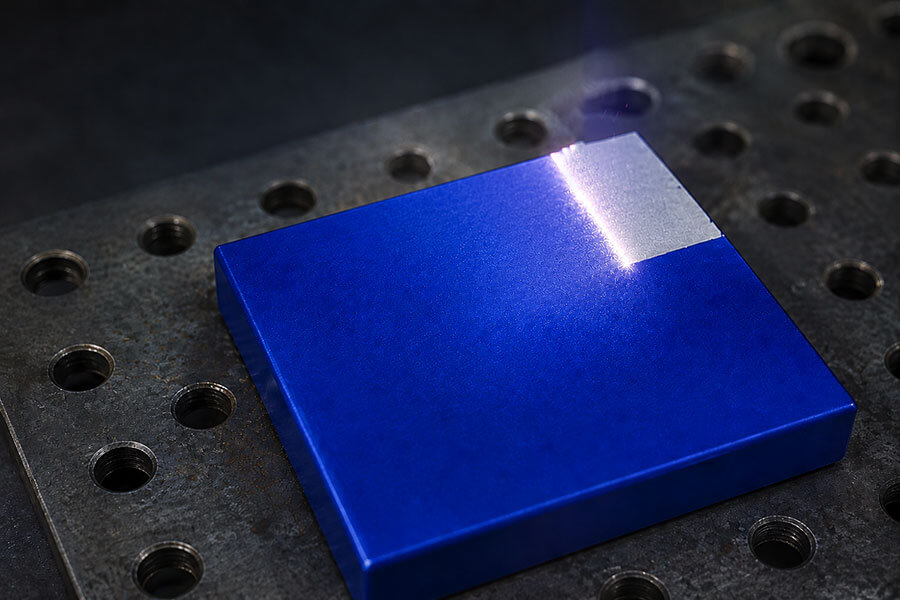
Using a top-hat beam or square laser spot minimizes damage to the aluminum battery housing. During processing, the temperature rise can be controlled below 10°C, preventing adverse effects on battery performance.
Laser cleaning provides an efficient method for cleaning industrial rollers. A high-energy laser beam rapidly removes rust, oxides, and oil contamination without causing mechanical wear or surface damage, preserving roller dimensional accuracy and extending service life.
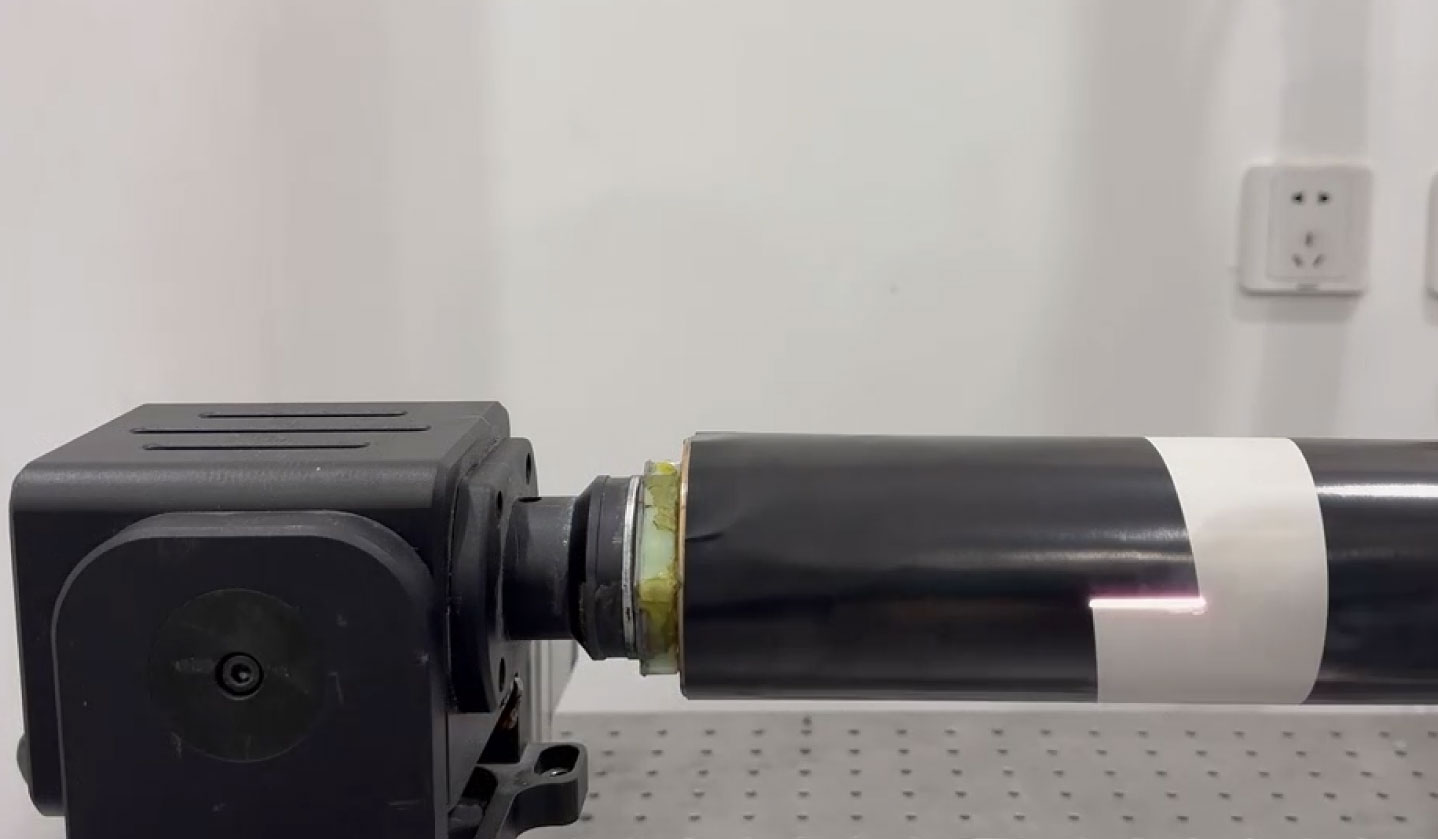
For illustration only
Laser cleaning is widely used to prepare battery tabs before welding. By removing coatings and surface contaminants from the weld area, laser cleaning ensures higher weld cleanliness, resulting in improved weld quality and enhanced battery safety.
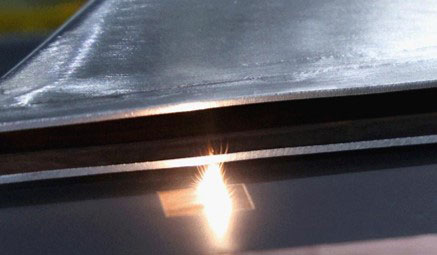
As industries continue to pursue higher productivity, greater automation, and improved product quality, laser cleaning is expected to play an increasingly important role in modern manufacturing. Achieving optimal cleaning performance, however, depends not only on the laser source but also on the integration of high-performance beam delivery components, including galvo scanners, F-Theta lenses, and advanced control systems. Together, these components enable higher processing speeds, improved cleaning consistency, and greater overall system efficiency, making laser cleaning a key technology for the future of advanced manufacturing.
 zh-CN
zh-CN
 English
  日本語
日本語  한국어
한국어  français
  Deutsch
  Español
  italiano
  русский
  português
  tiếng việt