EMAIL US
sales@scanneroptics.com
One of the key advantages of laser technology is its ability to concentrate energy into a small area, enabling precise material processing. The size and energy distribution of a focused laser spot are important factors affecting processing resolution, power density, and overall processing quality.
A focused laser spot is the concentrated region of light intensity formed near the focal plane when a collimated or approximately collimated laser beam passes through focusing optical components, such as lenses or mirrors. Due to the wave nature of light, laser focusing is subject to diffraction. Therefore, the actual laser spot is not an ideal geometric point but a region with a finite spatial size and a specific energy distribution.
In academic and industrial applications, laser spot size is commonly defined using the 1/e² intensity diameter, which is the diameter at which the intensity of a Gaussian beam falls to 1/e² (approximately 13.5%) of its peak value.
For a laser beam with an approximately Gaussian intensity distribution, the laser spot size can be estimated using the Gaussian beam focusing model.
Under appropriate focusing conditions, assuming paraxial propagation and a clearly defined incident beam diameter, the focused spot diameter can be approximated by:
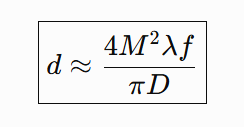
(d) is the focused spot diameter at the 1/e² intensity level.
(M2) is the beam quality factor.
(λ) is the laser wavelength.
(f) is the focal length of the focusing lens.
(D) is the incident beam diameter, which can be adjusted using a laser beam expander, measured at the 1/e² intensity level.
This formula is suitable for preliminary estimates under paraxial conditions, assuming a Gaussian-like beam and appropriate focusing geometry.
For F-theta scan lenses, the actual focused spot size also depends on the scan lens design, incident beam diameter, and beam quality. For application-specific calculations, refer to the lens manufacturer's specifications.
In addition to the core parameters included in the formula, several other factors play important roles in practical applications.
The ideal Gaussian beam formula assumes a perfect Gaussian beam with (M2 = 1). In practice, real laser beams may deviate from an ideal Gaussian profile. Beam quality is characterized by the beam quality factor, (M2), which describes how closely a beam approaches ideal Gaussian propagation.
A higher (M2) value indicates poorer beam quality. For a given wavelength, incident beam diameter, and focal length, a higher (M2) generally results in a larger focused spot.
Therefore, selecting a laser souce with a beam quality factor close to 1 is beneficial when a small focused spot is required.
Real optical systems exhibit aberrations, such as spherical aberration and coma, which can distort the focused spot and increase its size beyond the diffraction-limited value.
Selecting high-quality laser optics components with well-corrected aberrations helps achieve a smaller, more uniform spot. For galvanometer scanning applications, the focusing performance of the F-theta lens across the entire scan field should also be considered.
The defocus distance, defined as the distance between the workpiece surface and the focal plane, can significantly increase the effective spot size on the material. Precise focus positioning is therefore important for achieving consistent processing results.
Laser spot size directly affects how energy is distributed across the material surface, thereby influencing processing accuracy, power density, and efficiency. In applications such as laser marking, engraving, welding, cleaning, and micromachining, selecting an appropriate spot size is essential for achieving stable and consistent processing results.
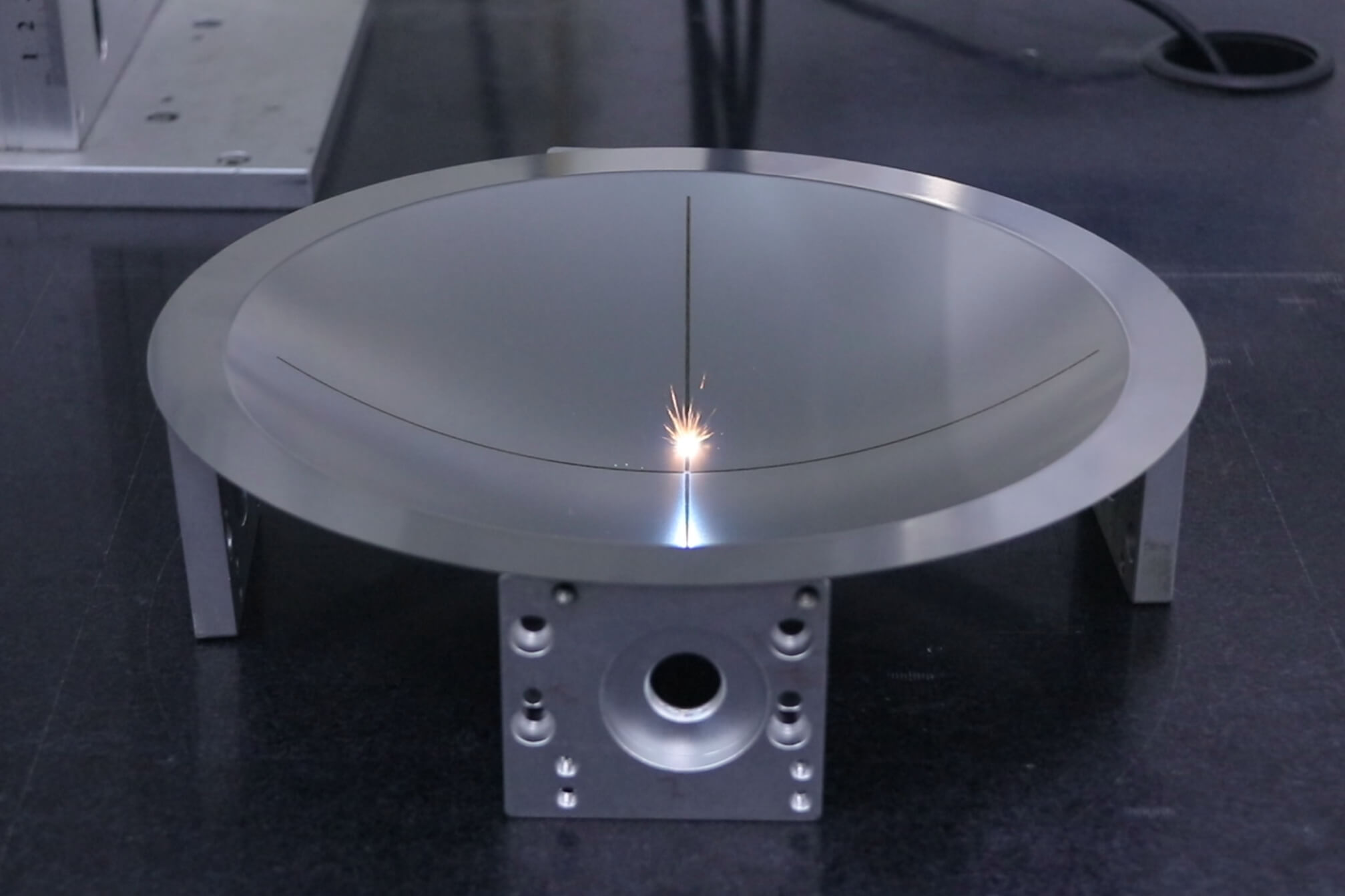
A smaller laser spot concentrates energy into a smaller area and generally produces a higher power density at the same laser power. This is particularly beneficial for fine marking, microstructuring, and localized material processing, where it can improve feature resolution and reduce thermal effects on surrounding areas. However, an excessively small spot may narrow the processing area and increase sensitivity to focus position and processing parameters.
A larger laser spot covers a wider area and can increase the coverage achieved in a single scan. This can be advantageous for certain large-area laser cleaning and surface treatment applications. However, at a constant laser power, increasing the spot size generally reduces the average power density, potentially requiring adjustments to laser power, scanning speed, or other processing parameters.
It is important to note that spot size alone does not determine the final processing result. Laser power, scanning speed, pulse duration, repetition rate, material absorption characteristics, and processing method also play important roles. The ideal spot size should therefore be selected according to the specific application requirements rather than simply aiming for the smallest possible spot.
Selecting a laser spot size is not simply a matter of minimizing its diameter. Instead, the spot characteristics must match the processing requirements and the capabilities of the optical system. The following three aspects provide a practical framework for evaluating the appropriate spot size.
Start by identifying the dimensions of the features to be processed, the required precision, and the overall processing area. These requirements help establish an approximate target spot size.
For example, fine marking and micromachining require careful consideration of both spot size and feature resolution, while large-area laser cleaning also requires consideration of processing coverage and throughput. For laser welding, the appropriate energy distribution should be determined according to the material, joint geometry, and welding process.
The target spot size should serve the desired processing outcome rather than simply minimize the diameter.
Once the target spot size has been determined, use the formula above to estimate the required focusing conditions and evaluate whether the laser output beam is compatible with the focusing optical system.
If the theoretical spot size does not meet the requirements, reconsider parameters such as the incident beam diameter, beam quality, and lens focal length.
For galvanometer scanning systems, the effective aperture and designed operating range of the F-theta lens must also be considered. Even if theoretical calculations predict the desired spot size, beam clipping or insufficient focusing performance at certain scan positions may cause the actual result to differ from the calculated value.
Theoretical calculations are useful for preliminary optical design, but they cannot fully replace practical testing. After selecting the optical parameters, evaluate the actual spot characteristics on the workpiece and assess how focus offset, workpiece height variations, and scan position affect processing results.
For large-field or high-precision galvanometer scanning systems, particular attention should be paid to differences in spot size between the center and edges of the scan field.
Ultimately, the selected optical configuration should be validated using both spot measurement results and actual processing quality to ensure that it meets the application requirements.
Laser spot size is an important parameter in laser processing, affecting power density, processing precision, and overall process performance. For an approximately Gaussian laser beam, the focused spot size can be estimated based on the laser wavelength, beam quality, incident beam diameter, and focusing lens focal length.
However, theoretical calculations alone cannot fully predict the spot size in a practical optical system. Optical aberrations, beam clipping, defocus, and scan position can all affect the actual focused spot. For galvanometer scanning applications, the design and performance of the F-theta lens must also be taken into account.
chieving the desired laser spot size requires a combination of theoretical calculation, appropriate optical system design, and experimental verification under actual processing conditions. Understanding these factors helps engineers develop laser processing systems that meet specific precision and performance requirements.
 zh-CN
 English
 日本語
 한국어
 français
 Deutsch
 Español
 italiano
 русский
 português
 tiếng việt