EMAIL US
sales@scanneroptics.com
Plastic parts are widely used in automotive, electronics, medical devices, industrial equipment, and consumer products. With the increasing demand for product traceability, anti-counterfeiting, and automated manufacturing, more and more manufacturers are adopting laser marking plastic technology to create permanent identification marks such as QR codes, serial numbers, logos, and text on plastic surfaces.
Plastic laser marking is a non-contact processing technology that uses a focused laser beam to modify the surface of plastic materials, creating clear and durable marks through color change, melting, foaming, or material removal. Compared with traditional printing and labeling methods, laser marking requires no consumables and offers advantages including high precision, high efficiency, and long-term durability.
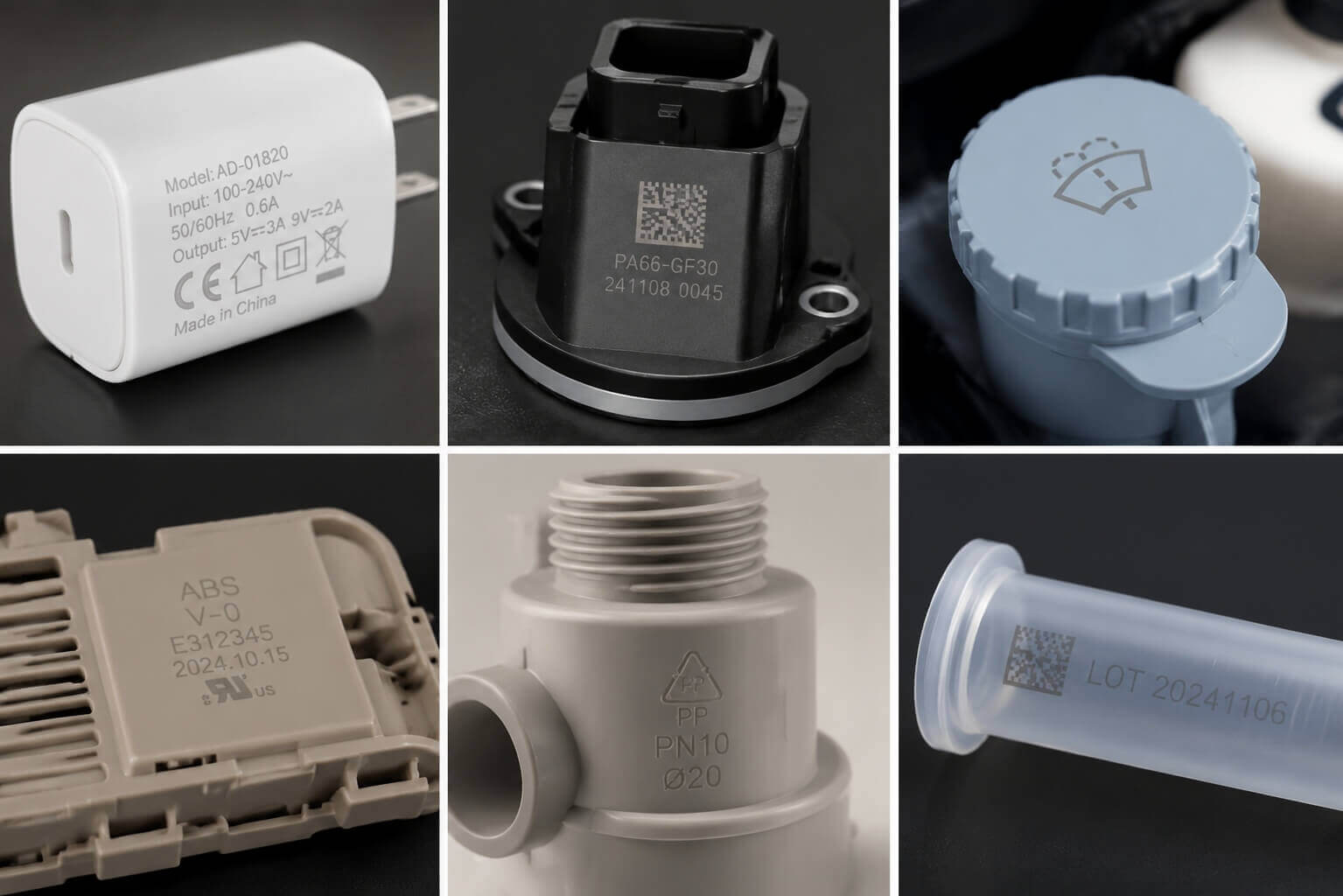
Plastic laser marking is a process that uses a high-energy-density laser beam generated by a laser source. Under the control of the galvo scanner and laser optics components, the laser output power and frequency are adjusted, and the focused laser beam is directed onto the surface of plastic parts.
The plastic material or laser marking additives absorb the laser energy and convert it into heat, causing physical or chemical changes such as melting, vaporization, or color modification. As the laser beam moves across the plastic surface, the processed area gradually forms the required patterns, text, or codes.
Depending on the plastic material and processing parameters, laser marking on plastics usually produces several different effects:
Some plastic materials are removed by laser energy, creating a recessed mark on the surface.
The plastic surface is locally melted to form a modified structure.
At high temperatures, chemical reactions occur between plastic materials and additives, resulting in permanent color changes.
The chemical structure, color, and additives of different plastics affect their laser absorption characteristics. Therefore, selecting the appropriate laser wavelength, power, and processing parameters is essential for achieving high-quality marking results.
Before selecting a laser marking solution, it is important to understand the characteristics of different materials. Many engineering plastics can be processed with laser technology, but the marking quality depends on material composition, additives, color, and surface treatment.
Common laser markable plastics include:
| Plastic Family | Common Materials | Typical Applications |
| Polyolefin | PP, PE | Food containers, stretch films, automotive parts, packaging |
| Styrene-Based Plastics | ABS | Automotive components, household appliances, medical devices |
| Polyvinyl Chloride | PVC | Pipes, flooring materials, swimming pool products, doors and windows |
| Polyester | PET, PETP, PBT | Bottles, textile fibers, automotive parts, electronic components |
| Polyacetal | POM, POM-C | Automotive electronic components, industrial parts such as gears and bearings |
| Acrylic | PMMA | Transparent covers, display panels, screens, optical components, packaging |
| Polyamide | PA (Nylon) | Textile fibers, automotive parts, industrial components |
| Polycarbonate | PC | Food packaging, pipes, medical components, automotive parts |
In laser marking plastic parts, the most commonly used laser sources are 1064nm fiber lasers and 355nm UV lasers. However, the optimal laser type depends on the plastic materal, color, application requirements, and desired marking effect.
| Laser Type | Wavelength | Application Characteristics | Common Applications |
| Fiber Laser | 1064nm | Widely used for general plastic marking applications | Automotive plastic parts, electronic housings, industrial components |
| UV Laser | 355nm | Suitable for precision marking with low thermal impact | Medical devices, electronics, precision plastic parts |
| Green Laser | 532nm | Used for special materials and transparent plastics | Transparent plastics, special polymers |
1064nm fiber lasers are widely adopted due to their high efficiency, stability, and compatibility with a broad range of plastic materials.
355nm UV lasers are preferred for applications requiring fine details, high contrast, and minimal thermal damage, such as medical and electronic components.
Plastic laser marking technology is widely used in automotive, electronics, medical, industrial manufacturing, and consumer product industries. With increasing requirements for product traceability, quality control, and automated production, more manufacturers are using laser technology to create permanent identification marks on plastic components.
| Industry | Typical Plastic Components | Common Marking Information | Application Benefits |
| Automotive | Interior parts, connectors, sensor housings, engine components | QR codes, serial numbers, part numbers, production dates, traceability codes | Enables part tracking and quality management throughout the product lifecycle |
| Electronics | Device housings, connectors, switches, electronic components | Logos, serial numbers, certification marks, micro QR codes, product information | Provides high-precision marking for small and complex plastic components |
| Medical Devices | Syringes, catheters, medical consumables, equipment housings | Product models, batch numbers, regulatory codes, tracking information | Offers permannet, wear-resistant, and chemical-resistant identification |
| Industrial Equipment | Tool housings, machine components, control panels, plastic enclosures | Brand logos, product codes, manufacturing data | Improves product identification and production management |
| Consumer Products & Packaging | Bottle caps, household appliances, plastic packaging components | Brand marks, anti-counterfeiting codes, product information | Provides durable marking without ink or labels |
Compared with traditional marking methods such as ink printing, labels, and mechanical engraving, plastic laser marking offers several significant advantages.
During the laser marking process, the laser head does not directly contact the plastic surface, avoiding mechanical stress, deformation, and tool wear.
The laser beam can be focused to a very small spot size, enabling fine lines, clear charcters, and detailed graphics. This makes laser marking suitable for small components and complex patterns.
Laser marking provides fast processing speeds and is especially suitable for automated production lines. Unlike ink printing, marked parts can be immediately moved to the next production stage without waiting for ink curing.
Laser-generated marks are resistant to friction, cleaning, and chemical exposure, providing excellent durability and long-term readability.
Laser marking does not require consumables such as ink, coatings, or solvents. The process produces no chemical waste, making it a more environmentally friendly marking solution compared with traditional printing methods.
The final marking quality depends on multiple factors, including laser parameters, material characteristics, and scanning system performance.
Higher laser power and longer pulse duration generally increase laser energy. However, excessive energy may cause plastic deformation, burning, or unwanted thermal damage.
Therefore, laser parameters should be optimized according to the specific plastic material and required marking effect.
Pulse width has a significant influence on marking quaity.
A shorter pulse width can reduce heat accumulation and minimize thermal damage, making it suitable for applications requiring clean and precise marks.
Scanning speed and laser frequency directly affect processing efficiency and marking appearance.
Extremely low speed or unsuitable frequency settings may cause excessive heat accumulation and burning. After determining suitable laser parameters, higher scanning speeds can improve production efficiency.
The galvo scanner is one of the core motion control components in a laser marking system. It controls the laser beam movement across the working area with high speed and precision.
The scanning speed, positioning accuracy, repeatability, and long-term stability of the galvanometer scanner directly affect final marking quality.
A high-performance galvo scanner helps maintain accurate scanning trajectories during high-speed processing
For high-precision applications in electronics, semiconductors, and medical devices, digital galvanometer scanners with high-resolution encoders, low drift characteristics, and fast dynamic response are preferred.
Different materials have different laser absorption rates, thermal conductivity, and reaction mechanisms, requiring different processing parameters.
For example:
1.Plastic materials require controlled thermal effects to avoid burning or unwanted discoloration.
2.Metals require consideration of reflectivity and melting characteristics.
3.Transparent materials such as glass usually require UV or green lasers for high-quality processing.
In addition, material color, surface treatment, and additive content can significantly influence the final marking result.
Choosing the right plastic laser marking system requires consideration of material type, marking requirements, production efficiency, and application conditions.
Because different plastics have different laser absorption characteristics, selecting the appropriate laser source is essential for achieving high-quality marking results.
For common automotive plastic parts, electronic housings, and industrial plastic components, 1064nm fiber lasers provide a widely applicable solution with high speed and excellent stability.
For medical devices, precision electronics, and applications requiring minimal thermal impact, 355nm UV lasers can provide finer and clearer marking results.
Besides the laser source, the performance of the galvo scanner also plays an important role in plastic marking quality. Scanner Optics provides a range of high-precision galvo scanners designed for laser marking applications, including fiber laser, UV laser, and CO₂ laser processing. With features such as high positioning accuracy, fast response speed, and stable long-term operation, Scanner Optics galvo scanners help achieve consistent marking quality for automotive components, electronic housings, medical plastics, and other industrial applications.
 zh-CN
zh-CN
 English
  日本語
日本語  한국어
한국어  français
  Deutsch
  Español
  italiano
  русский
  português
  tiếng việt